Engineering Economy 18th Edition Engineering Economy 18th Edition

Solution manual

Engineering Economy 18th Edition


Covering Topics Such As The Time Value Of Money, Cash Flow Analysis, Present, Annual, And Future Worth Methods.
Description

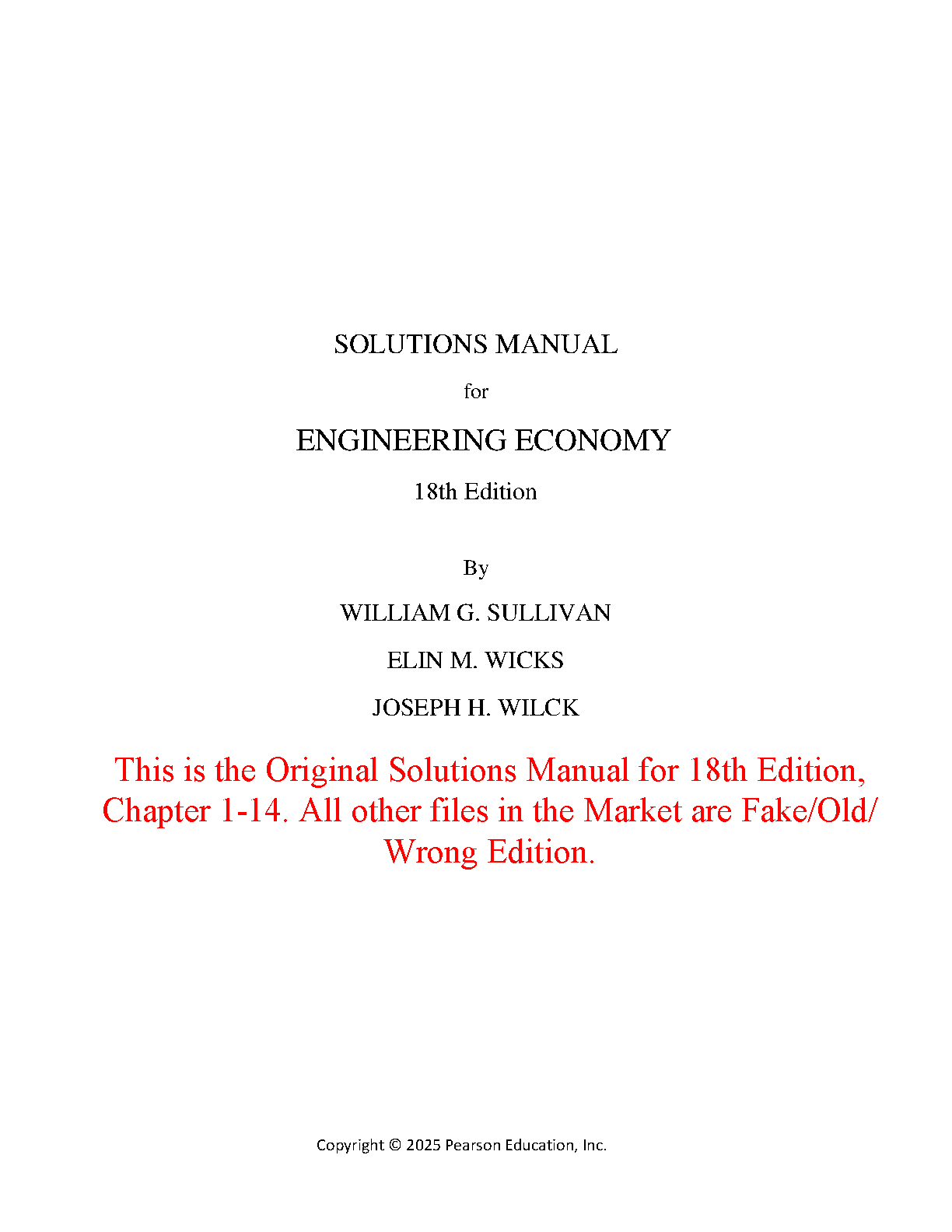
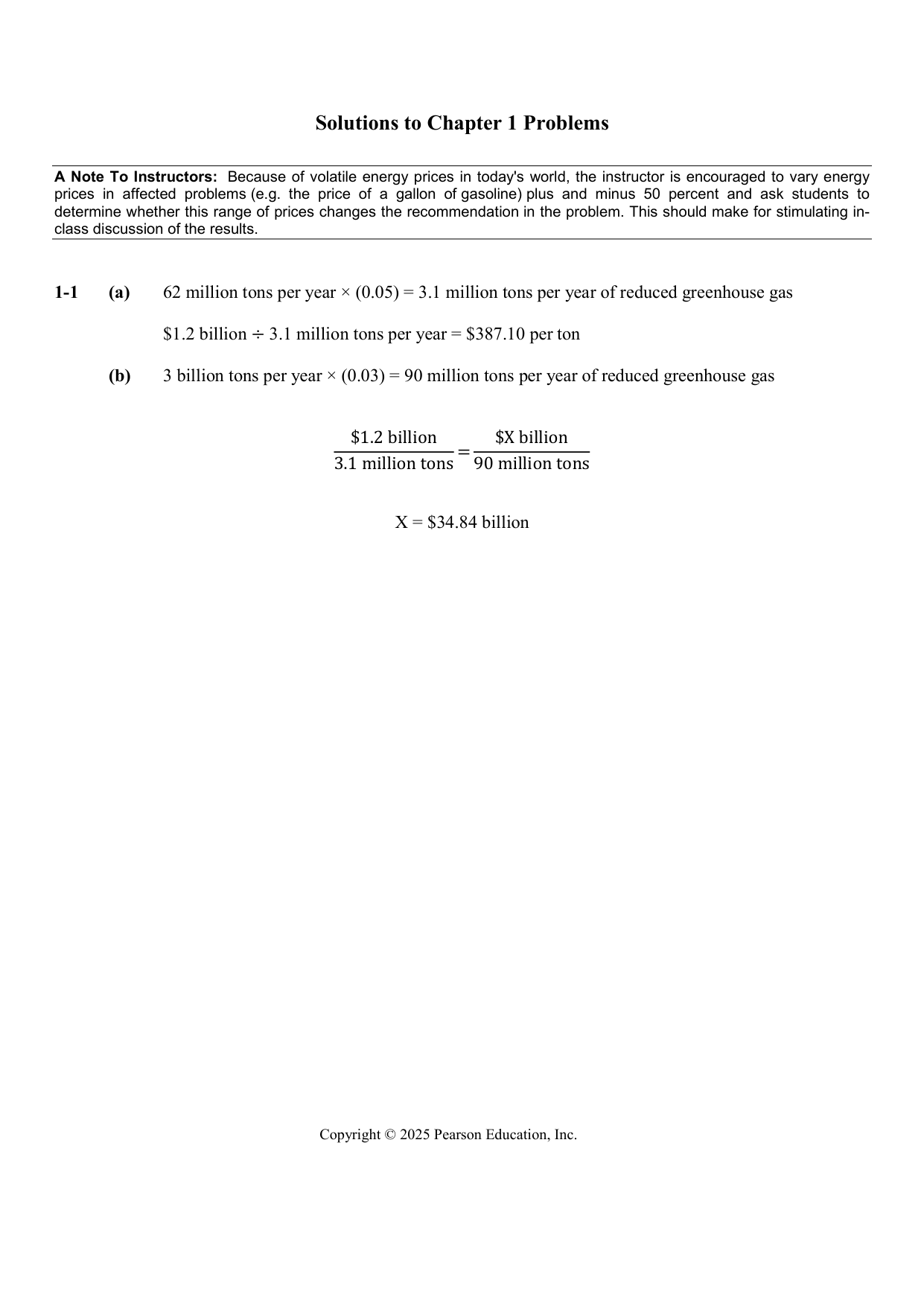
Solutions Manual for Engineering Economy, 18th Edition by William G. Sullivan, Elin M. Wicks, and Joseph H. Wilck is a comprehensive instructor resource developed to support the teaching and application of engineering economics. Designed to accompany the textbook, it provides detailed, step-by-step solutions to end-of-chapter problems, enabling instructors to verify calculations, demonstrate analytical methods, and illustrate sound engineering economic decision-making.

The resource offers worked solutions for a wide range of textbook exercises, making it easier for educators to prepare lectures, classroom demonstrations, tutorials, homework assignments, and examinations. Each solution follows a structured problem-solving approach that emphasizes selecting appropriate economic models, performing accurate financial calculations, and interpreting results within the context of engineering projects and business decisions.

Coverage begins with the fundamental principles of engineering economy, including economic decision-making, cost estimation, cash flow concepts, opportunity costs, and the role of financial analysis in engineering practice. Students learn how engineers evaluate alternatives by balancing technical performance with economic feasibility.

The solutions manual provides extensive coverage of the time value of money, including simple and compound interest, nominal and effective interest rates, economic equivalence, cash flow diagrams, present worth, future worth, annual worth, sinking funds, capital recovery, and uniform and gradient cash flow series. Step-by-step solutions demonstrate the proper application of engineering economy formulas and financial factors to solve quantitative problems accurately.

Comprehensive guidance is provided for investment evaluation methods, including present worth analysis, annual worth analysis, future worth analysis, internal rate of return, incremental rate of return, benefit–cost analysis, and payback period calculations. Students develop the ability to compare competing alternatives and determine the most economically attractive engineering solutions.

The resource also addresses depreciation, income taxes, after-tax cash flow analysis, and inflation, illustrating how taxation policies, depreciation methods, and changing economic conditions affect engineering investments and long-term financial planning. Worked examples reinforce the interpretation of financial statements and project profitability.

Solutions are included for replacement analysis, equipment selection, asset management, life-cycle costing, and capital budgeting. Students learn how to evaluate equipment replacement decisions, estimate total ownership costs, compare alternatives with different service lives, and optimize capital investments over the life cycle of engineering assets.

Additional chapters focus on risk and uncertainty, probability-based economic analysis, sensitivity analysis, scenario evaluation, and break-even analysis. These topics help learners understand how uncertainty influences engineering decisions and how analytical tools can improve confidence in investment recommendations.


PDF Sample
1 / 3
Engineering Economy 18th Edition IMG-1
Engineering Economy 18th Edition IMG-2
Engineering Economy 18th Edition IMG-3
Who is this Document for ?

Engineering, Economy students, instructors, and exam preparation users.
What you will learn ?
Explain the fundamental concepts and principles of engineering economy and their role in engineering decision-making.
Apply the time value of money to analyze engineering investments and financial alternatives.
Construct and interpret cash flow diagrams for engineering and business projects.
Calculate present worth, future worth, and annual worth using standard engineering economy techniques.
Apply simple and compound interest formulas to evaluate financial transactions and investment opportunities.
Analyze uniform, arithmetic gradient, and geometric gradient cash flow series.
Compare engineering alternatives using present worth, annual worth, future worth, and incremental analysis methods.
Evaluate projects using internal rate of return (IRR), incremental rate of return, and minimum attractive rate of return (MARR) concepts.
Apply benefit–cost analysis to assess the economic feasibility of engineering and public-sector projects.
Calculate payback periods and assess their strengths and limitations in investment evaluation.
Apply depreciation methods to determine asset values, tax implications, and financial performance.
Analyze after-tax cash flows and evaluate the effects of income taxes on engineering investments.
Assess the impact of inflation and changing economic conditions on project costs and investment decisions.
Perform replacement analysis to determine the optimal timing for replacing engineering assets and equipment.
Apply life-cycle cost analysis to compare the long-term economic performance of engineering alternatives.
Develop capital budgeting analyses to support engineering project selection and resource allocation.
Evaluate engineering projects under conditions of risk and uncertainty using probability and sensitivity analysis techniques.
Conduct break-even analyses to support operational and investment decisions.
Estimate project costs and analyze cost behavior throughout the engineering project life cycle.
Use spreadsheets and computational tools to perform engineering economy calculations accurately and efficiently.
Interpret engineering economic results to support planning, budgeting, and strategic decision-making.
Integrate technical, financial, environmental, and managerial considerations when evaluating engineering alternatives.
Demonstrate systematic problem-solving using quantitative analysis and engineering economy models.
Apply ethical and professional principles to financial decision-making in engineering practice.
Use engineering economy concepts to support informed decision-making in engineering, manufacturing, construction, infrastructure, energy, technology, and project management.
What do you get with this PDF ?
Instant access after purchase
Download in PDF format
DRM free, read anywhere
Document details
Last update :
Jul 29, 2026
Length :
830 pages
Edition :
2026
Language :
English
Category :
Keywords
Engineering Economy Engineering Economics Economic Analysis Financial Analysis Engineering Decision-making Time Value Of Money Cash Flow Analysis Cash Flow Diagrams Present Worth Analysis Future Worth Analysis Annual Worth Analysis Equivalent Annual Worth Present Value Future Value Economic Equivalence Simple Interest Compound Interest Nominal Interest Rate Effective Interest Rate Discount Rate Discounting Compounding Uniform Series Arithmetic Gradient Geometric Gradient Capital Recovery Sinking Fund Investment Analysis Project Evaluation Capital Budgeting Engineering Finance Cost Estimation Fixed Costs Variable Costs Direct Costs Indirect Costs Opportunity Cost Sunk Cost Depreciation Straight-line Depreciation Declining Balance Depreciation Macrs Depreciation Book Value Salvage Value Income Taxes After-tax Cash Flow Inflation Purchasing Power Replacement Analysis Equipment Replacement Asset Management Life-cycle Costing Life-cycle Cost Analysis Economic Life Service Life Break-even Analysis Benefit–cost Analysis Benefit–cost Ratio Internal Rate Of Return (irr) Incremental Rate Of Return Minimum Attractive Rate Of Return (marr) Payback Period Discounted Payback Period Risk Analysis Uncertainty Analysis Sensitivity Analysis Scenario Analysis Probability Analysis Decision Analysis Engineering Project Evaluation Infrastructure Economics Manufacturing Economics Construction Economics Industrial Engineering Systems Engineering Engineering Management Operations Management Project Management Resource Allocation Financial Modeling Spreadsheet Analysis Quantitative Analysis Mathematical Modeling Optimization Investment Decisions Engineering Planning Cost Control Economic Feasibility Engineering Education Analytical Thinking Problem Solving Financial Forecasting Business Economics Professional Engineering Practice.
You may also be interested in :
Recommendations for you
Understanding EKGs: A Practical Approach, 5th Edition
Understanding Ekgs: A Practical Approach, 5th Edition

Practice Test Bank Covering Electrocardiography Principles, Waveform Analysis, Arrhyt...

$16
Sears & Zemansky's College Physics, 9th Edition

It Covers Mechanics, Thermodynamics, Waves, Electricity, Magnetism, Optics, And Moder...

$17
Engineering Economy 15th Edition

Is A Comprehensive Instructor Resource Designed To Support The Teaching Of Engineerin...

$16
Engineering Economy 17th Global Edition

Is An Instructor Support Resource Designed To Assist With The Accurate Application Of...

$17