
Solution manual
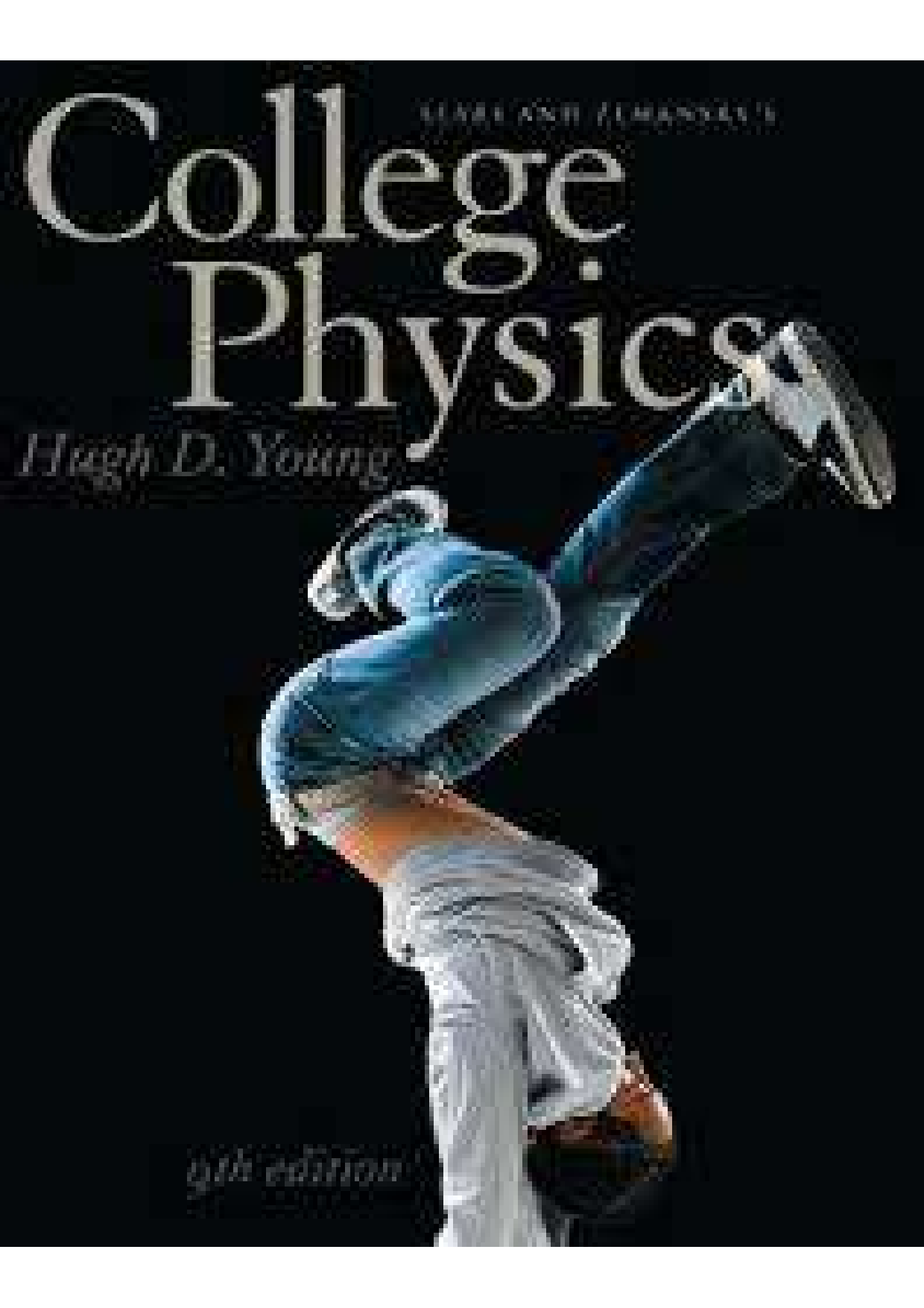
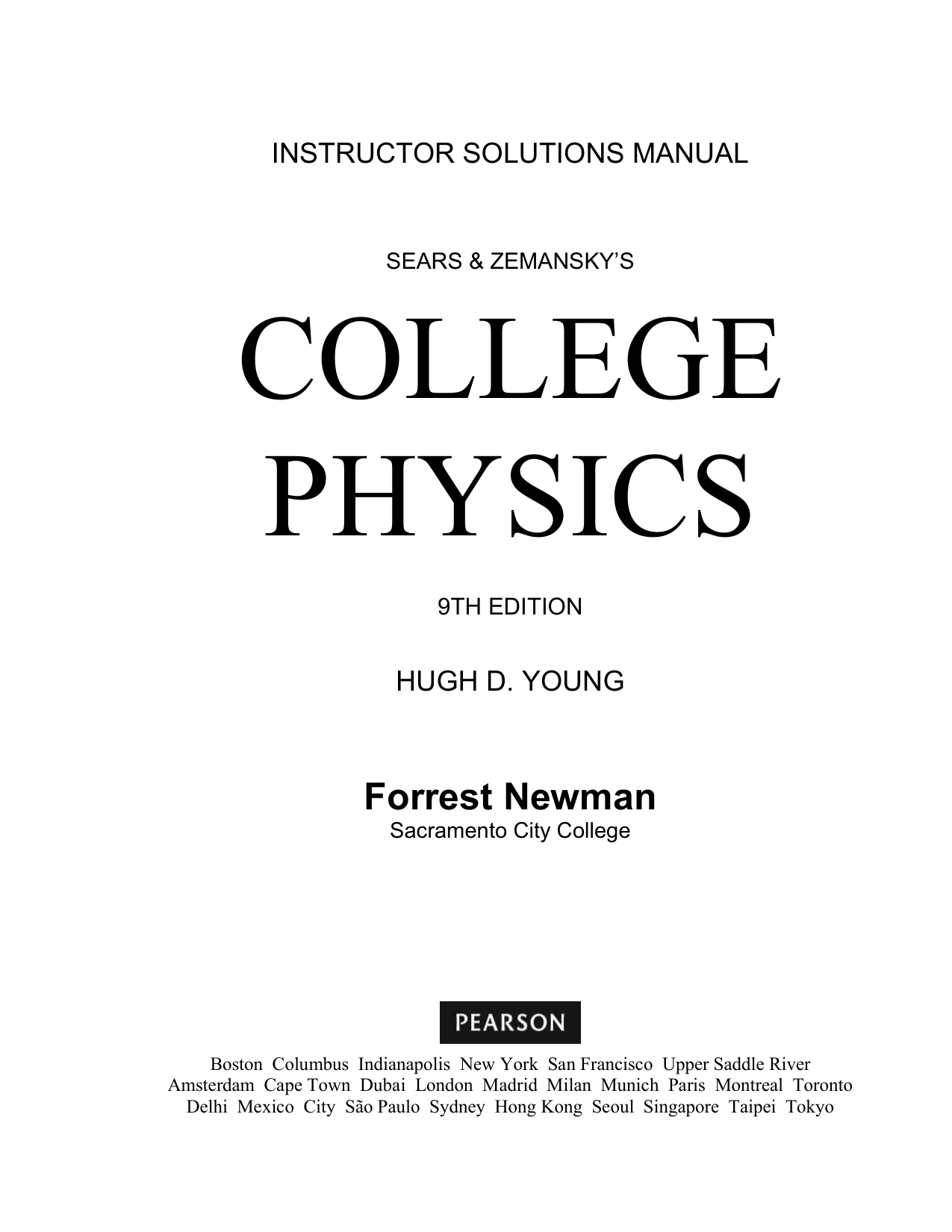
Solution Manual For Sears & Zemansky's College Physics, 9th Edition By Hugh D. Young
Solution Manual for Sears & Zemansky's College Physics, 9th Edition by Hugh D. Young is a comprehensive instructor resource designed to support the teaching and learning of introductory college physics. Developed to accompany the textbook, it provides detailed, step-by-step solutions to end-of-chapter problems, enabling instructors to verify calculations, demonstrate effective problem-solving techniques, and explain fundamental physics concepts with clarity and accuracy.
The manual covers a broad range of topics presented throughout the textbook, including mechanics, motion in one and two dimensions, Newton's laws of motion, work and energy, momentum, rotational motion, gravitation, oscillations, fluid mechanics, thermodynamics, waves, sound, electricity, magnetism, optics, and modern physics. Each solution follows a logical sequence that emphasizes conceptual understanding, mathematical reasoning, and the correct application of physical principles.
Solutions are presented in a clear and organized format, showing each stage of the problem-solving process from identifying known variables and selecting appropriate equations to performing calculations and interpreting final results. This structured approach helps instructors explain complex concepts while reinforcing students' analytical and quantitative reasoning skills.
The resource places strong emphasis on applying physics concepts to practical situations through numerical examples and real-world applications. Students learn how to solve problems involving forces, motion, energy conservation, electric circuits, magnetic fields, wave behavior, geometric optics, and basic atomic and nuclear physics using systematic scientific methods.
In addition to strengthening mathematical proficiency, the solutions manual promotes critical thinking by encouraging learners to analyze physical situations, evaluate assumptions, and interpret the significance of calculated results. Many worked examples illustrate how theoretical principles apply to engineering, technology, healthcare, environmental science, and everyday physical phenomena.
The manual serves as a valuable instructional aid for preparing lectures, classroom demonstrations, tutorials, homework discussions, laboratory activities, quizzes, and examinations. Instructors can use the detailed solutions to reinforce problem-solving strategies, explain difficult concepts, and support students with varying levels of physics and mathematics preparation.
Suitable for introductory college physics courses, engineering technology programs, health science education, and other STEM disciplines, the resource helps build a solid foundation in classical physics while preparing students for more advanced scientific and engineering studies.
Overall, the Solution Manual for Sears & Zemansky's College Physics, 9th Edition is an essential teaching resource that supports effective instruction, reinforces core physics principles, strengthens analytical problem-solving skills, and helps students develop confidence in applying physics concepts to academic, laboratory, and real-world applications.

Undergraduate students enrolled in introductory college physics courses.
Students studying engineering, engineering technology, and applied sciences.
Physics majors seeking additional practice with quantitative problem-solving and conceptual understanding.
Students in health sciences, pre-medical, nursing, and allied health programs requiring a foundation in physics.
Instructors and professors teaching algebra-based college physics who need worked solutions for lectures, tutorials, and classroom demonstrations.
Teaching assistants supporting laboratory sessions, discussion groups, and recitation classes.
Academic institutions and training centers offering physics, engineering, and STEM education programs.
Students preparing for quizzes, midterm examinations, final exams, and standardized assessments in introductory physics.
Tutors and academic support professionals assisting learners with physics concepts and problem-solving techniques.
Self-learners and professionals seeking to strengthen their understanding of mechanics, thermodynamics, electricity, magnetism, optics, waves, and modern physics.

Master The AHIP Final Exam With Verified Questions, Detailed Solutions, And Expert In...
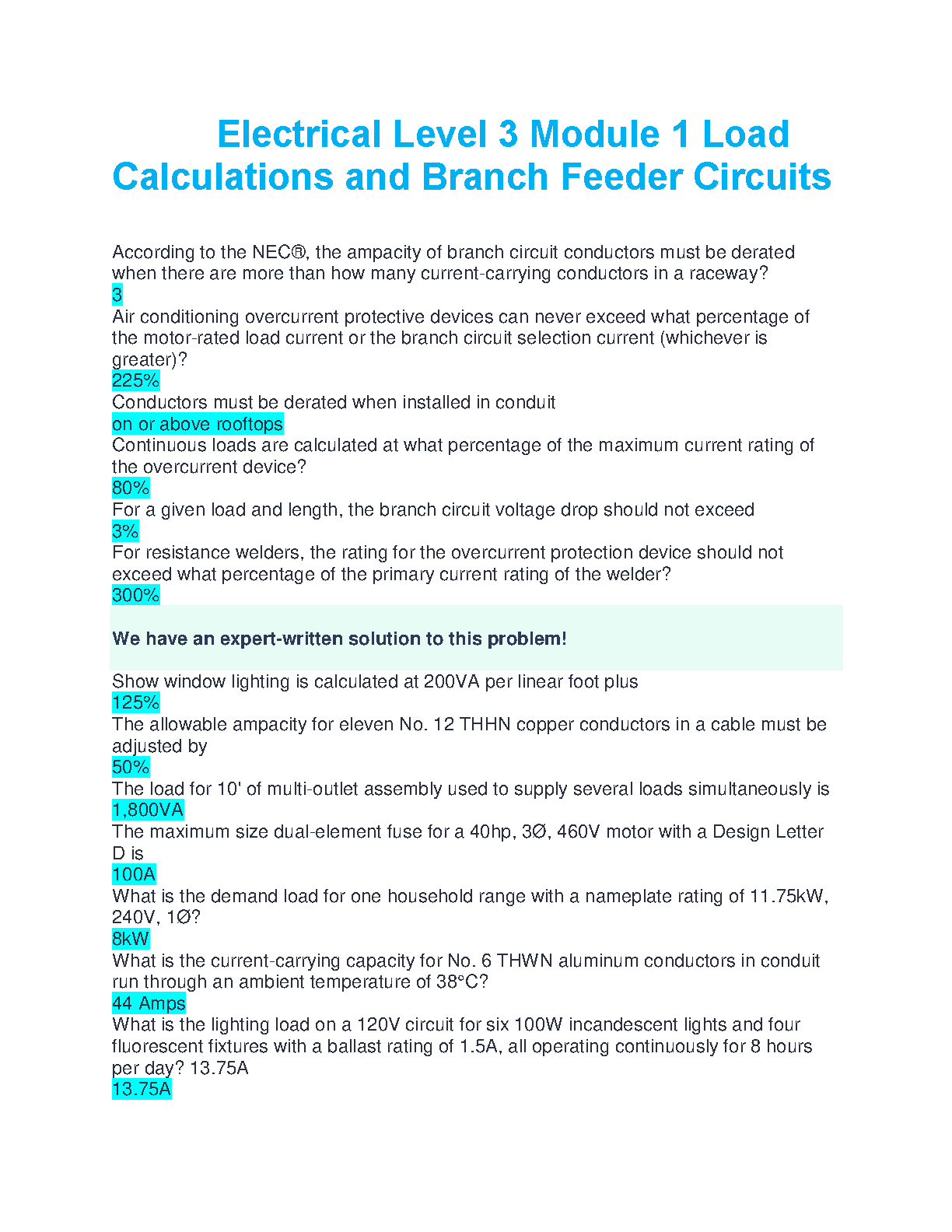
Master Level 3 Electrical Load Calculations And Branch Feeders With Expert Solutions....
Master The Abfm Ite Exam With Detailed Answers And Explanations. Avoid Resits And Ach...

Master The ANCC Ne-bc Exam With Complete Answers And Detailed Explanations For Confid...