
AQA GCSE Chem Paper 1F 2026 MS AQA GCSE Chem Paper 1F 2026 MS

Solution manual

AQA GCSE Combined Science Chemistry Paper 1f Foundation Mark Scheme June 2026 Exam Answers And Assessment Criteria Guide


Download The Official AQA GCSE Chemistry Paper 1f 2026 Mark Scheme. Master Assessment Objectives, Grading Criteria, And Exam Answers.
Description

Mastering the specific marking nuances of the Foundation tier is essential for maximising score outcomes in the AQA Combined Science curriculum. This resource provides a precise breakdown of examiner expectations for Chemistry Paper 1F, highlighting exactly how points are allocated across key theoretical concepts. By studying these official assessment criteria, learners can refine their technical writing to align with examiner standards and avoid common pitfalls. It serves as an indispensable tool for transforming raw content knowledge into high-scoring exam responses.

PDF Sample
1 / 3
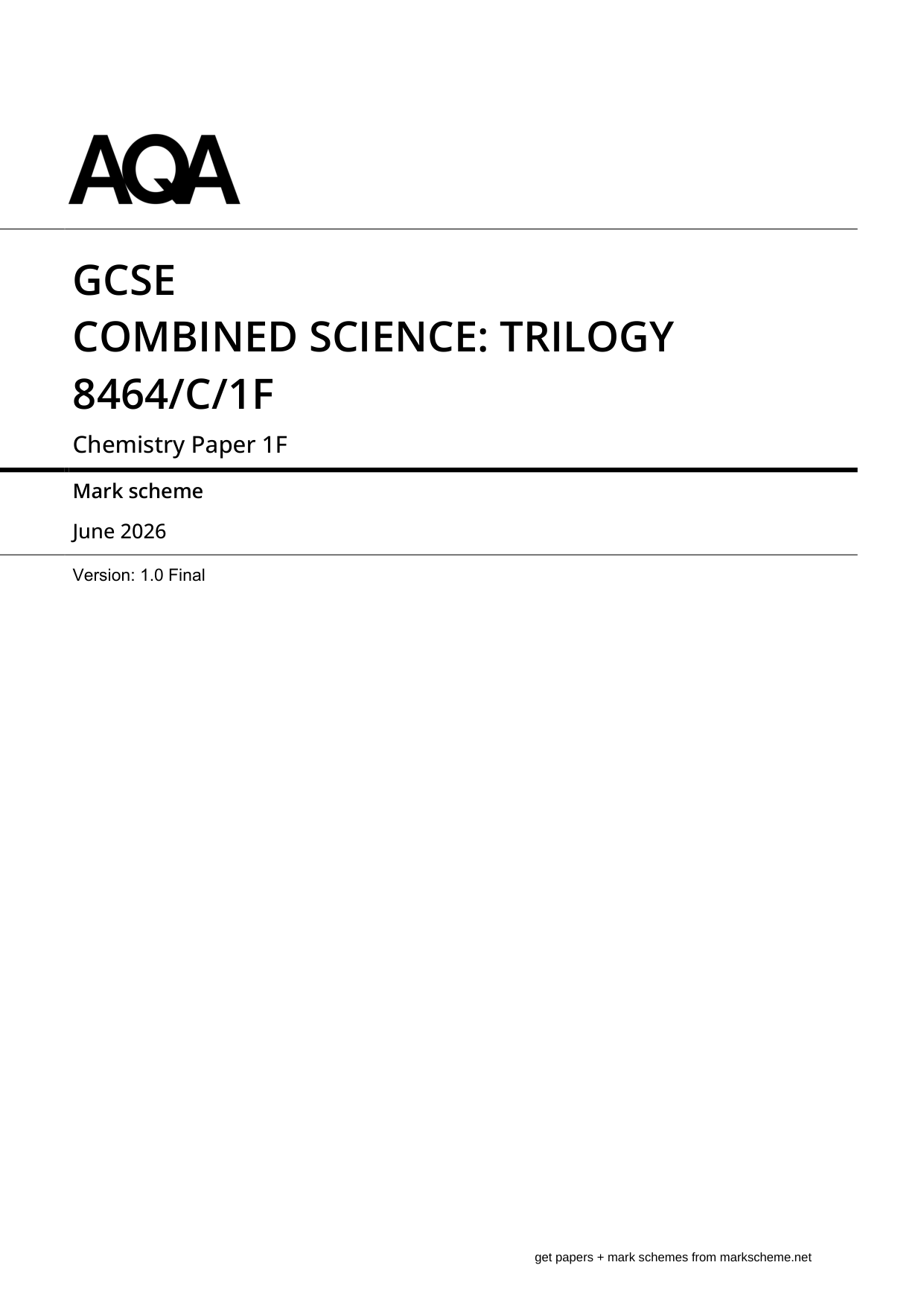
AQA GCSE Chem Paper 1F 2026 MS IMG-1
AQA GCSE Chem Paper 1F 2026 MS IMG-2
AQA GCSE Chem Paper 1F 2026 MS IMG-3
Who is this Document for ?

This document is specifically designed for GCSE students sitting the Foundation Tier of AQA Combined Science: Trilogy Chemistry. It serves as a critical reference for teachers and tutors aiming to align their marking feedback with official examiner protocols. Revision candidates will benefit from using this guide to self-assess their answers against standardised criteria.

What you will learn ?
⬤Identify how periodic table groups and trends are used to describe element properties, ensuring precise terminology that meets assessment objectives for high-scoring responses in Section A questions.
⬤Apply atomic structure knowledge and chemical formulae conventions accurately to represent elements and compounds, avoiding common structural errors that lead to mark deductions in foundational chemistry topics.
⬤Evaluate the reactivity of metals with acids and outline correct laboratory techniques for preparing salts, demonstrating practical understanding required by the examiner for experimental method questions.
⬤Describe state changes and reduction processes using appropriate scientific language, clarifying the distinction between physical changes and chemical reactions as assessed in Paper 1F objectives.
⬤Analyse how ionic compounds are electrolysed, identifying electrode products and explaining the movement of ions to secure full marks on practical application queries related to electrochemical cells.
⬤Calculate energy changes occurring in displacement reactions by interpreting data accurately, showing working steps that satisfy the assessment criteria for mathematical problem-solving within chemistry contexts.
⬤Explain how bonding and structure affect material properties, linking microscopic arrangements to macroscopic behaviours such as conductivity or hardness to answer extended-response questions effectively.
You may also be interested in :
Recommendations for you
AQA A Level Mathematics Paper 1 June 2026 Mark Scheme for May 2027 Exam Preparation and Revision Strategy
AQA A Level Mathematics Paper 1 June 2026 Mark Scheme For Ma...

Download The AQA A Level Maths Paper 1 June 2026 Mark Scheme. Master Differentiation,...

$16
AQA GCSE Combined Science Biology Paper 2F Foundation Mark Scheme June 2026 Detailed Guide
AQA GCSE Combined Science Biology Paper 2f Foundation Mark S...

Download The AQA GCSE Combined Science Biology Paper 2f Mark Scheme For June 2027. Id...

$16
AQA GCSE Combined Science Chemistry Paper 2 Foundation June 2027 Mark Scheme Official Resource for Exam Preparation
AQA GCSE Combined Science Chemistry Paper 2 Foundation June...

Download The Official AQA GCSE Combined Science Chemistry Paper 2 Foundation Mark Sch...

$16
OCR GCSE Chemistry B J258/02 Depth in Chemistry Foundation Mark Scheme June 2022 Official Answers and Assessment Criteria for Students
OCR GCSE Chemistry B J258/02 Depth In Chemistry Foundation M...

Official OCR GCSE Chem B J258/02 Mark Scheme. Master Depth In Chemistry Marking Crite...

$16