
AQA A-Level Chem P2 2027 Mark Scheme | Past Paper Answers AQA A-Level Chem P2 2027 Mark Scheme | Past Paper Answers

Solution manual

AQA A Level Chemistry Paper 2 June 2027 Mark Scheme: Organic Mechanisms And Kinetics Answer Guide


Download The AQA A Level Chemistry Paper 2 June 2027 Mark Scheme. Master Organic Mechanisms, Kinetics, And Ester Reactions With Detailed Answers.
Description

Enhance your exam performance by mastering the precise marking criteria for rate equations, reaction mechanisms, and stereoisomerism in A Level Chemistry. This resource provides a clear breakdown of how examiners assess complex organic analysis data and halogenoalkane reactions, ensuring you meet every mark requirement without guesswork. Use this guide to refine your technique in identifying carboxylic acid derivatives and interpreting chemical data accurately. By aligning your answers with the official 2027 paper specifications, you build the confidence needed to tackle high-stakes assessment objectives effectively.

PDF Sample
1 / 3
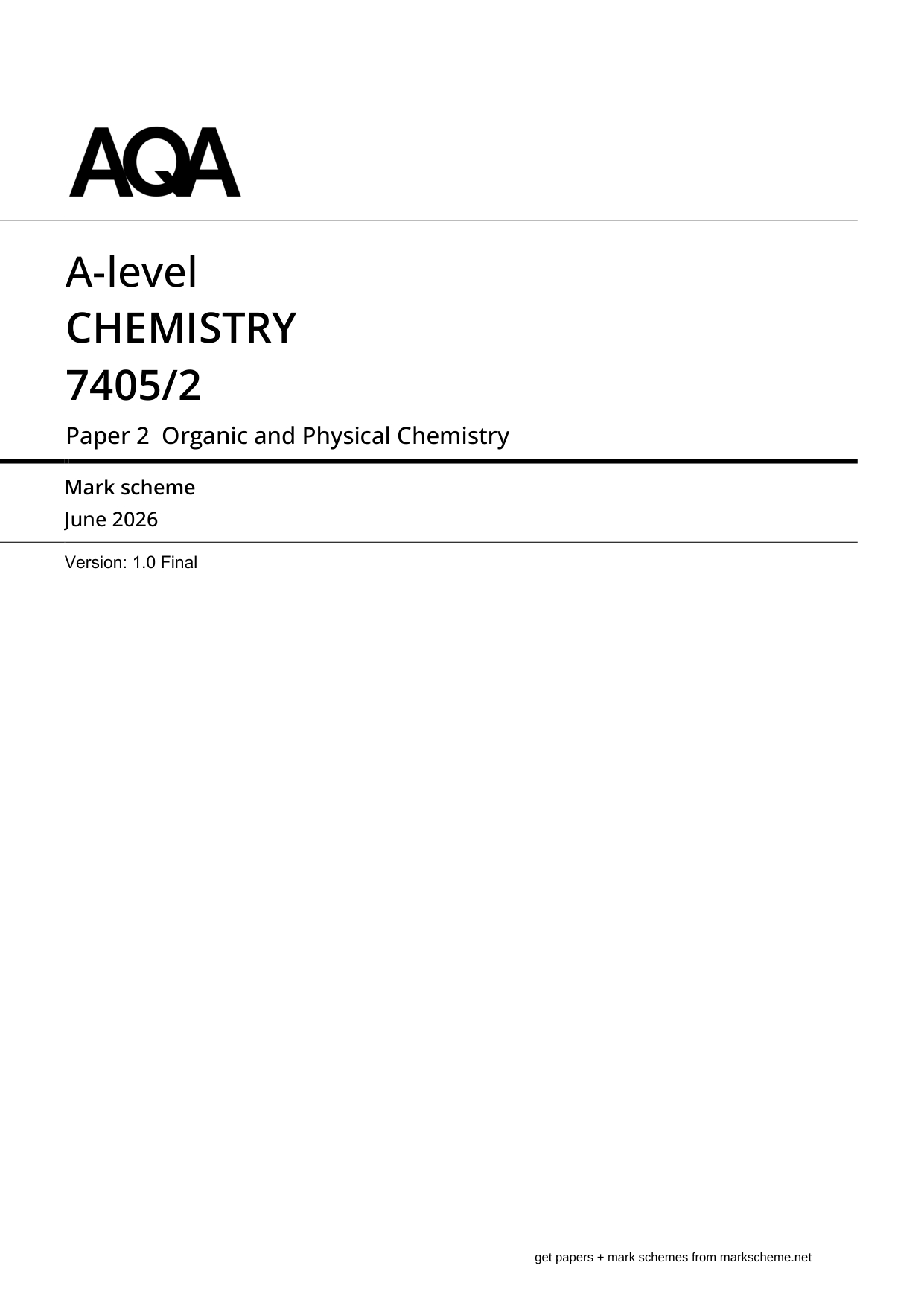
AQA A-Level Chem P2 2027 Mark Scheme | Past Paper Answers IMG-1
AQA A-Level Chem P2 2027 Mark Scheme | Past Paper Answers IMG-2
AQA A-Level Chem P2 2027 Mark Scheme | Past Paper Answers IMG-3
Who is this Document for ?

This document is essential for A Level students preparing for the June 2027 AQA Chemistry Paper 2 examination. Teachers and tutors will find it valuable as a reference tool for demonstrating how to structure answers that align with examiner expectations. Revision candidates seeking to understand specific marking points in organic chemistry sections, such as mechanisms and stereochemistry, will benefit most from this detailed breakdown.

What you will learn ?
⬤Interpret reaction-rate data by applying rate equations correctly, ensuring you can deduce the order of reaction and calculate constants as required by examiner standards. Understand how to present kinetic analysis clearly to secure full marks for mathematical accuracy in chemical contexts. Practise identifying common pitfalls in interpreting graphs or tabular data related to reaction rates.
⬤Explain organic reaction mechanisms with precision, focusing on the movement of electron pairs and intermediate structures. Learn to articulate step-by-step processes that satisfy assessment objectives regarding mechanistic reasoning, reducing errors in arrow-pushing conventions often penalised by examiners. Gain confidence in describing nucleophilic substitution versus elimination pathways under specific conditions.
⬤Analyse halogenoalkane reactions and their outcomes based on substrate structure and reagent strength. Identify the key factors influencing reaction rates and product formation, enabling you to predict major products in multi-step organic sequences. Understand how examiners expect students to justify the choice of reaction pathway using chemical evidence from the question stem.
⬤Identify and apply the specific reactions involved in carboxylic acid esterification and hydrolysis processes. Learn to distinguish between different esterification conditions and their impact on yield, a critical area for securing marks in organic synthesis questions. Master the nomenclature of complex esters and acyl derivatives as required by AQA specification.
⬤Interpret chemical data using standard organic analysis methods such as IR spectroscopy and NMR interpretation principles where applicable to the paper's scope. Develop the ability to deduce structures from functional group tests and quantitative data, a high-value skill for higher-order assessment objectives. Practice integrating multiple pieces of analytical evidence to reach a single definitive structural conclusion.
⬤Apply concepts of stereoisomerism to determine chiral centres and predict enantiomeric relationships in organic molecules. Understand how to represent stereochemistry using wedge-and-dash notation correctly, avoiding common marking errors related to perspective drawing. Learn why specific stereochemical outcomes occur in asymmetric synthesis contexts covered in Paper 2.
⬤Review the specific mark scheme language for Paper 2 questions from June 2027 to align your answer style with official requirements. Identify where partial credit is awarded and how wording precision affects final scores in extended response sections. Use this knowledge to self-assess past practice papers more effectively, focusing on areas that currently lose unnecessary marks.
You may also be interested in :
Recommendations for you
AQA GCSE Combined Science Chemistry Paper 1F Foundation Mark Scheme June 2026 Exam Answers and Assessment Criteria Guide
AQA GCSE Combined Science Chemistry Paper 1f Foundation Mark...

Download The Official AQA GCSE Chemistry Paper 1f 2026 Mark Scheme. Master Assessment...

$16
AQA GCSE Combined Science Chemistry Paper 2 Foundation June 2027 Mark Scheme Official Resource for Exam Preparation
AQA GCSE Combined Science Chemistry Paper 2 Foundation June...

Download The Official AQA GCSE Combined Science Chemistry Paper 2 Foundation Mark Sch...

$16
OCR GCSE Chemistry B J258/02 Depth in Chemistry Foundation Mark Scheme June 2022 Official Answers and Assessment Criteria for Students
OCR GCSE Chemistry B J258/02 Depth In Chemistry Foundation M...

Official OCR GCSE Chem B J258/02 Mark Scheme. Master Depth In Chemistry Marking Crite...

$16
Test Bank and Student Solutions Manual to Accompany Atkins' Physical Chemistry, 10th Edition by Charles Trapp, Marshall Cady, and Carmen Giunta
Test Bank And Student Solutions Manual To Accompany Atkins'...

Educational Resources For Students Studying Thermodynamics, Quantum Chemistry, Kineti...

$18